

<img height="1" width="1" style="display:none;" alt="" src="https://px.ads.linkedin.com/collect/?pid=6061692&amp;fmt=gif">
Skip to content

Search the Goodlord website

  • There are no suggestions because the search field is empty.
An open printed report on a dark teal background with a grid of small green dots and a faint building facade behind it. The left page shows the title “The PRS Sentiment Index” with the subtitle “More certainty, less pessimism,” a “Key Takeaways” list, and a large faded “01” chapter number. The right page shows a line chart titled “Fig 1: Net sentiment over time” above columns of body text.
2026

State of the Lettings Industry Report

Goodlord’s 9th annual report on the private rented sector surveys 3,031 agents, landlords, and tenants.

Foreword & Executive Summary

Security and the search for a home

The Renters’ Rights Act (RRA) is widely seen as a win for tenants. And for those already in a home, our data largely supports that. 77% feel secure in their tenancy, and tenant optimism is the highest we’ve ever recorded.

But not everyone feels this security. The RRA is leaving certain tenants out in the cold.

Around half of agents (51%) and landlords (50%) have become more cautious when choosing tenants since the RRA became effective. A quarter of landlords (26%) say the ban on rent in advance has made them more likely to reject applicants they would once have accepted.

The market is dividing into insiders, better protected than ever, and outsiders, who face a more selective search.

That is not what the government set out to do.

It banned discrimination against tenants on benefits and those with children to give vulnerable renters a fighting chance. However, vulnerable groups without specific protections already seem to be bearing the brunt of the RRA, as this report will show.

Our research, based on testimony from 442 agents, 589 landlords, and 2,000 tenants surveyed in August 2026, will explore this, as well as a range of other key findings.

A person climbing a tall metal ladder up the side of a large white wall, nearly at the top, against a clear blue sky.

Key findings

  1. Certainty has eased pessimism

    Our PRS Sentiment Index shows net sentiment improving from −21 to −8 among agents and from −70 to −58 among landlords. Both groups remain negative, but knowing the rules appears to have helped.

  2. Scale shapes who copes

    Agencies with 11 or more staff are net positive about the sector (+10), while those with 10 or fewer are net negative (−18).

  3. Tenant awareness of the Renters’ Rights Act is mixed

    Over a quarter (26%) of tenants in England have never heard of the Act, while nearly a quarter (24%) of tenants have used AI to understand their rights. 59% of agents already see tenants using the technology to raise complaints.

  4. Some fears have eased, but others are coming true

    Our Renters’ Rights Act Scorecard tests last year’s predictions against early experience. Pet requests and rent increase appeals have proved less disruptive than expected, but agents and landlords are now far more cautious about who they rent to.

  5. Agents report supply and demand challenges

    Half of agents report falling rental availability and 45% rising enquiries from tenants, while 27% of landlords are reducing or trying to reduce their portfolios.

  6. Labour’s favourability with tenants is fragile

    Tenants are the most positive about the incumbent government, with 27% believing that Labour will have the most positive impact on housing. However, with affordability stretched and housebuilding off target, their faith could be tested.

  7. Sentiment about future reforms is nose diving

    Sentiment about future reforms has cooled sharply. Agents’ net view of the landlord database has fallen from +28 to −13, suggesting the more they learn, the less they like.

william-reeve-1

William Reeve

CEO, Goodlord

“There’s a well-known concept in economics about the labour market. In countries with the strongest job protections, it’s often the people looking for work who struggle most. The explanation is simple. When it’s hard to let someone go, employers become very careful about who they take on. The people already inside are protected. Everyone else finds it harder to get in.

“I think the Renters’ Rights Act risks doing the same thing to housing. For tenants who already have a home, it’s a real gain, and the government deserves credit for that. But every new let is now a bigger commitment for a landlord, so the bar for getting through the door is rising.

“The people who lose out are those already on the margins. The self-employed, those with patchy credit, those with County Court Judgments (CCJs), and those without a UK guarantor. The RRA hasn’t made all tenants winners. It has made insiders winners, whilst unwittingly making it harder to become one. If we want greater security to mean something, it has to be available to the renter looking for their next home, not just the one who already has it.”

3,031 respondents surveyed, August 2026.

442 letting professionals, 589 landlords, and 2,000 tenants. Agent and tenant surveys cover the UK; landlords cover England and Wales.  Questions about the Renters’ Rights Act were asked only of agents based in England, landlords with property in England, and tenants renting in England.

Section 01

The PRS Sentiment Index

More certainty, less pessimism

Key takeaways

  • Agents and landlords are less pessimistic than last year. Greater certainty about the rules may offer some reassurance, even among those who disagree with the changes.
  • Larger agencies report greater optimism. Conversely, landlords with 6+ properties are more pessimistic.
  • Tenants are the most optimistic audience, particularly those under 35, but affordability challenges could test that confidence over the long term.

A woman with red hair, wearing a long red coat, black beret, jeans and black boots, stands on a doorstep reaching for the handle of a white front door with ornate stone surrounds.
Fig 1: Net sentiment over time
  1. May 2023 · Renters Reform Bill announced
  2. May 2024 · Renters Reform Bill thrown out
  3. Sept 2024 · Renters’ Rights Bill announced
  4. Oct 2025 · Renters’ Rights Bill becomes law
  5. May 2026 · Renters' Rights Act takes effect
Fig 1: Net sentiment over time
Group 2023202420252026
Landlords -38-65-70-58
Agents -19-31-21-8
Tenants -26-27-141

Each point is the Oct/Nov State of the Lettings Industry report for that year. Landlord and tenant sentiment wasn’t tracked until 2023, which is why the Index starts here. Successive survey samples, not the same respondents tracked over time. Source: SOTLI surveys 2023–2026.

For agents and landlords, the last few years have been tumultuous. 

Significant reform to the private rented sector has been on the cards since the Conservative government released its white paper, A Fairer Private Rented Sector, in June 2022. This, of course, preceded the Renters Reform Bill, which was first announced in May 2023.

However, the legislation stalled when the Conservative government failed to pass it before Labour’s Keir Starmer replaced Rishi Sunak in Number 10. Our sentiment readings reflect that unsettled period. Agents were most pessimistic at this juncture, but it took another year for landlord pessimism to bottom out.

As we’ll come to in the next chapter, some of the reforms proposed by the Renters’ Rights Act haven’t been as negative as expected for landlords, which adds context to the uptick in sentiment in 2026.

When you combine agent and landlord sentiment, it’s clear both groups are more comfortable with the devil they know, but both are still broadly unhappy with the sector’s direction of travel.

Tenant optimism makes for a different picture. 

It has risen by 17 percentage points, from 20% in 2025 to 37% in 2026: its highest level across the four surveys we’ve conducted. That optimism comes at a time when many tenants still haven’t heard of the Act, as we’ll come to later. Interestingly, pessimism has also risen from 34% to 36%, leaving net sentiment at +1.

This split owes much to the age breakdown of respondents. Younger demographics are generally more hopeful, with half of those aged 25-34 (50%) and almost half of 18-24-year-olds (48%) optimistic, whereas pessimism reaches 40% among those aged 55-64.

The mood turns earlier than might be expected. Pessimism is already 38% among renters aged 35-54. The government’s goodwill among tenants rests largely with those under 35, and the affordability pressures covered later in this report could test it.

37%

of tenants are optimistic about the PRS – the highest rate on record

36%

are still pessimistic, meaning tenants are only just optimistic overall

Section 01 · Scale

Scale changes the experience

42%

of agencies with 11+ staff are optimistic; only 28% with five or fewer are

Larger agencies report greater optimism about the changing market. Optimism reaches 42% among agencies with 11 or more staff, compared with 28% among those with five or fewer. The direction is similar when agencies are grouped by the number of properties they manage. 41% of those managing 500 or more are optimistic, while only 28% of those managing fewer properties are optimistic.

Pessimism is more common among smaller operations. 45% of respondents from agencies with five or fewer staff are pessimistic, compared with 32% from those with 11 or more. Among agencies managing fewer than 500 properties, 45% are pessimistic.

This gap was visible last year. In our 2025 survey, 44% of agencies with two to five staff said they weren’t prepared for the Renters’ Rights Act, compared with 6% of those with 11 to 25. A year on, smaller agencies are the most pessimistic about the sector, suggesting that early disadvantage is now playing out in how they are adapting.

Fig 2: Optimism/pessimism by agency staff size

Net

  • All agents n=435

    Pessimistic (left) 40%, Optimistic (right) 32%, net minus 8.
  • 1–5 staff n=189

    Pessimistic (left) 45%, Optimistic (right) 28%, net minus 17.
  • 6–10 staff † n=95

    Pessimistic (left) 44%, Optimistic (right) 26%, net minus 18.
  • 11+ staff n=149

    Pessimistic (left) 32%, Optimistic (right) 42%, net +10.

Net = % optimistic minus % pessimistic. † = base under 100; excludes skipped. Source: SOTLI agent survey 2026.

Headshot of Tom Goodman

Tom Goodman

Managing Director at Goodlord

“Last year, we anticipated that the changes brought about by the Renters’ Rights Act would place a disproportionate burden on smaller letting agencies, which often have fewer resources to absorb additional administration, adapt their processes, and manage the associated costs.

“This year’s findings suggest that concern is becoming a reality, with a growing divide emerging between agencies in how they are experiencing and responding to the changing landscape. For smaller agents in particular, having the right support, systems, and protection in place will be crucial to navigating the transition and remaining competitive.”
For landlords, the pattern runs the other way. Pessimism reaches 81% among those with six or more properties, compared with 70% among those with two to five and 63% among single-property landlords.*

Preparing for database registration and identifying which homes may need EPC upgrades will only add to the work facing landlords with larger portfolios. This is an opportunity for agents to lend a helping hand.

Among landlords with six or more properties, 56% use an agent across their whole portfolio and 35% use one for only some properties. Understanding where these owners need help with the homes they manage themselves could open up new work with existing clients. With generating revenue a priority for 60% of agents, those conversations could serve both sides.

*Landlords with 6+ properties are grouped because of small sample sizes. The group with 6-10 properties contains 54 respondents (9%), the group with 11-20 properties contains 24 respondents (4%) and the group with 20+ properties contains 11 respondents (2%). As a result, this grouping better reflects landlords with 6-10 properties than any other.

Fig 3: Pessimism by landlord portfolio size
  • 63%

    1 property n=246

  • 70%

    2–5 properties n=242

  • 81%

    6+ properties † n=89

  • 69%

    All landlords n=578

% somewhat or very pessimistic; † base under 100, treat as indicative. Source: SOTLI landlord survey 2026.

Section 01 · Politics

Political confidence remains fragile

68%

of agents say the government is ineffective at making renting more affordable

Our survey shows that 60% of landlords and 48% of agents rate the current government as effective at improving tenant rights.

Fig 4: Who would have the most positive impact on housing?

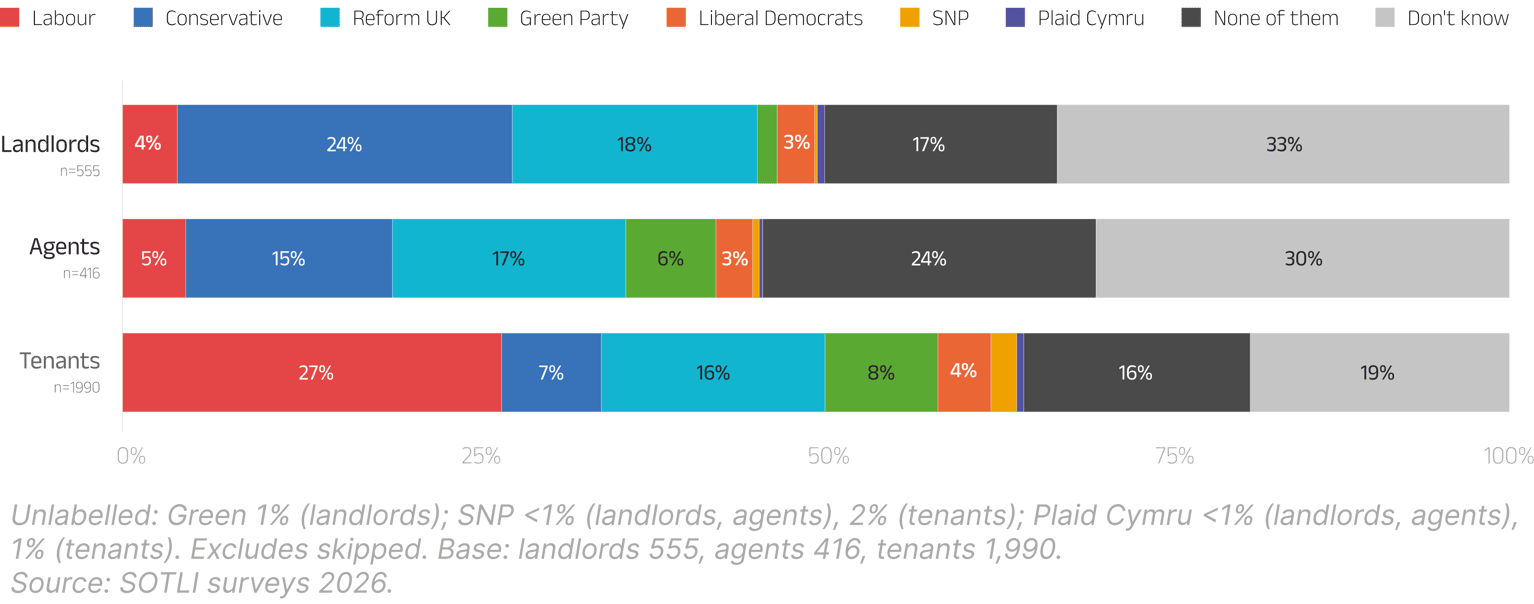
Fig 4: Who would have the most positive impact on housing? Labour is chosen by 4% of landlords, 5% of agents and 27% of tenants. “None of them” and “Don’t know” together account for half of landlords and over half of agents.

Ask whether the government listens, though, and the responses are much less complimentary. Among landlords, 83% consider the government ineffective at listening to them; 70% of agents say the same about its engagement with their profession. On making renting more affordable, 67% of landlords and 68% of agents rate the government as ineffective.

Confidence in its ability to support supply is also weak. Only 4% of landlords consider the government effective at encouraging investment in the PRS, while 64% of agents rate its efforts as ineffective. On preventing landlords from leaving the sector, 69% of landlords and 61% of agents judge it ineffective.

These concerns leave considerable uncertainty about who could do better.

Across all three audiences, many remain unconvinced by any political party. “Don’t know” and “None of them” together account for 54% of agents, 50% of landlords, and 35% of tenants. Agents are the most likely to reject every party, with 24% saying none of them would have a positive impact.

Among landlords, the Conservatives lead the named parties at 24%, followed by Reform UK at 18% and Labour at 4%. Agents put Reform UK at 17% and the Conservatives at 15%.

Tenants are more inclined to favour Labour on housing, with 27% selecting it as the party that would have the most positive impact. However, they are well short of majority support, with right-leaning parties still favoured by almost a quarter (23%) of tenants. Reform UK’s appeal to tenants grows with age, from 11% of tenants under 35 favouring the party on housing, compared to 22% of those over 55.

Section 02

Letting under the new rules

Checking the forecast: The Renters’ Rights Act Scorecard

Key takeaways

  • Possession and tenancy management remain difficult adjustments. Agents are recommending protection, stronger referencing checks, and help to retain good tenants.
  • Landlords have responded to the ban on rent in advance with caution, and they’re less likely to take risks on applicants with poor credit or without UK guarantors.
  • Rent increase appeals and pet reforms have caused less disruption than agents anticipated.

A block of flats with rows of balconies lit orange by low sunlight, beside a darker residential tower in shadow, under a deep teal sky with an aeroplane contrail.

Long before the Renters’ Rights Act became law, agent and landlord groups accepted that the private rented sector needed reform and that tenants needed a stronger voice.

When the 2021 Queen’s Speech committed the government to rental reform, Ben Beadle, Chief Executive of the National Residential Landlords Association (NRLA), backed its aim of driving bad landlords out of the sector. But he urged the government to use the time ahead to “ensure that the reforms are fair and workable for both tenants and landlords.”

Five years on, most landlords and agents feel that plea went unheard. As chapter 1 showed, 83% of landlords say the government is ineffective at listening to them, and 70% of agents say the same about its engagement with their profession. That matters for tenants too, because reforms that don’t work for the people letting homes are less likely to work for the people renting them.

The ban on rent in advance shows why.

It was widely seen as a way of stopping tenants being ripped off. But the industry warned it would remove a lifeline for renters without a UK guarantor, a strong credit history, or a typical income. This year’s survey suggests those fears are starting to materialise.

There are encouraging findings too. Most tenants feel secure, some are using their new flexibility to move, and rent-increase appeals have proved less disruptive than agents expected so far.

The challenge is to sustain those gains while making sure renters can still secure a home and afford to stay.

Our Renters’ Rights Act Scorecard compares last year’s expectations with the experiences reported in this year’s survey. Here’s how things have played out.

The Renters’ Rights Act Scorecard

  • ▲ Tenants

    Tenants will feel more secure in their homes, while having greater freedom to leave

  • ■ Agents● Landlords

    Periodic tenancies will increase the risk of unexpected departures and voids

  • ■ Agents● Landlords

    Possession will become slower, costlier, and less predictable

  • ■ Agents● Landlords

    Banning rent in advance will create an insider vs outsider divide

  • ■ Agents

    Agents’ renewal revenue will be wiped out, leaving a financial black hole

  • ■ Agents● Landlords

    Pet requests will create widespread disruption

  • ■ Agents

    Rent increases will face frequent challenges

  • ■ Agents● Landlords

    The transition to periodic tenancies will mean tenants come and go more often

Forecast = 2025 expectation

Actual = 2026 experience

positive

milder than feared

partly true

negative

warning signs

SOTLI surveys 2025–2026. Agent and tenant surveys cover the UK; the landlord survey covers England and Wales. Questions about the Renters’ Rights Act were asked only of agents based in England, landlords with property in England, and tenants renting in England.

Of the main concerns raised last year, two have come true, two have partly come true, one is showing early warning signs, and two have proved less disruptive than expected.

The fears that have materialised are largely operational:

  • Possession is taking longer
  • Periodic tenancies are making departures and voids harder to predict

Those that have eased so far relate to tenant behaviour, with pet requests and rent increase appeals causing less disruption than agents expected. Most of these reforms had been in force for around three months when we surveyed, so several verdicts could change as the legislation beds in.

  • Prediction 1 of 8 ·▲ Tenants

    Tenants will feel more secure in their homes, while having greater freedom to leave

Tenants’ sense of security is an early win for the Act. Of the tenants surveyed, 77% say they feel secure in their tenancy.

Only 7% of tenants in England have served notice since May 1, 2026. Of that group, 70% say the Renters’ Rights Act influenced their decision. 44% moved sooner than planned, and 26% say they would not have moved without it. That’s equivalent to around 3% of tenants in England moving sooner because of the Act, and 2% who wouldn’t have moved at all.

These early findings are encouraging and support the government’s stated aims. The flexibility to leave is already making a difference to some tenants. For those who want to stay, feeling secure in their home matters just as much.

Tenants are still learning what has changed

Around half of tenants had heard of the legislation last year, so awareness is growing. However, there is still some way to go before they fully understand their rights. Later on, we’ll explore how tenants are using AI to help.

68%

have heard of the Act; 26% haven’t, 6% unsure

47%

recognise the ability to leave a periodic tenancy with two months’ notice

43%

know they can challenge a rent increase at the First-tier Tribunal

32%

believe landlords cannot refuse a pet request at all

Headshot of Nye Jones

Nye Jones

Head of Campaigns at Generation Rent

“Homes are the foundations of our lives. The Renters’ Rights Act was a vital first step in addressing the power imbalance between tenants and landlords. We’re delighted to see renters are feeling more secure in their homes and are exercising their new rights. It’s now vital the private rented sector works together to make sure the remaining elements of the new law build on the success we have seen in the first six months.”

  • Prediction 2 of 8 ·■ Agents● Landlords

    Periodic tenancies will increase the risk of unexpected departures and voids

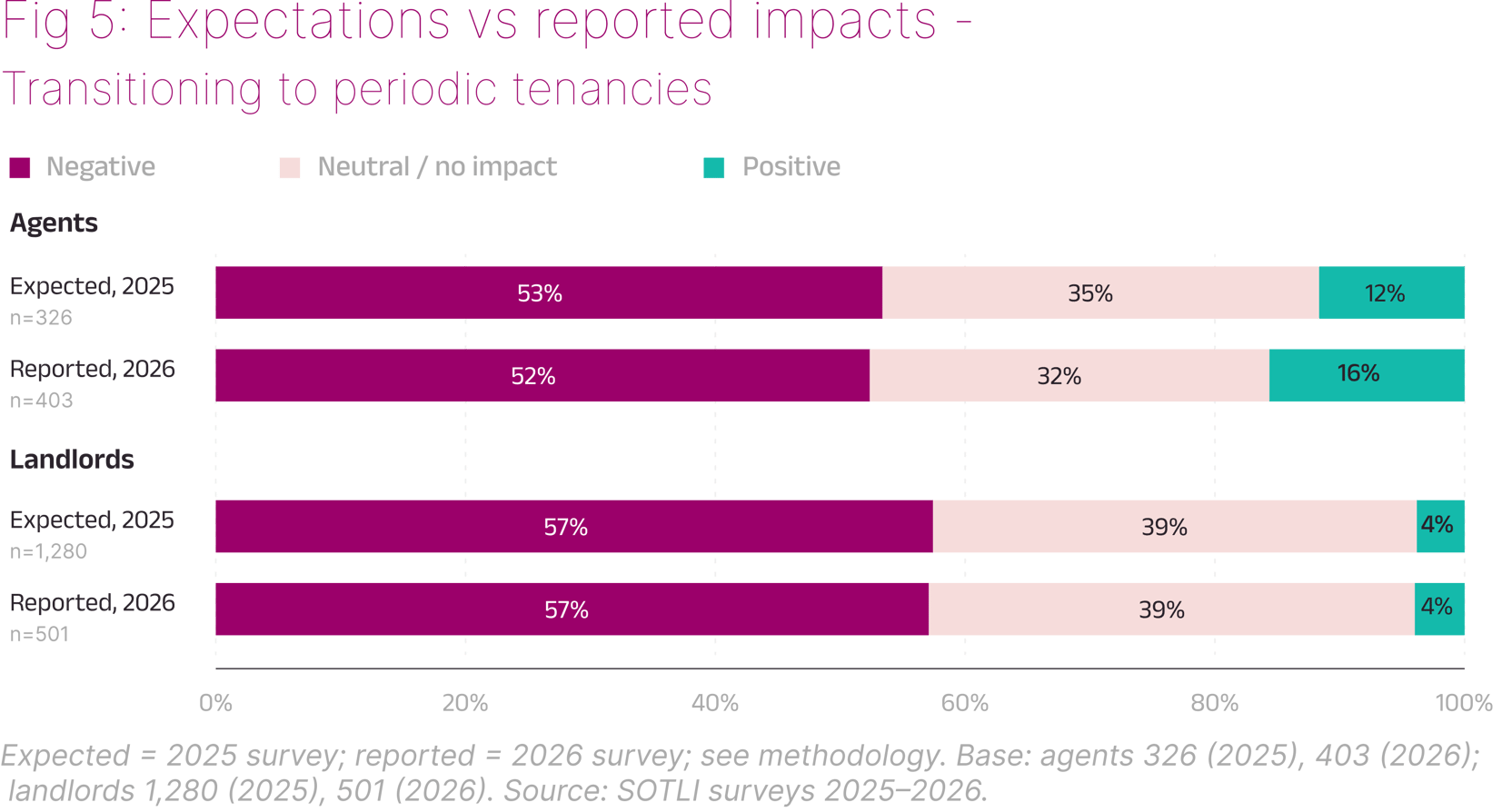
The move away from fixed terms has had a negative impact for 52% of agents and 57% of landlords. Among agents specifically, 57% report an increased risk of unexpected departures and void periods and 46% find tenancy management more unpredictable.

These concerns reflect the difficulty of planning around a tenancy whose end date is less certain.

Fig 5: Expectations vs reported impacts - Transitioning to periodic tenancies 

Fig 5: Expectations vs reported impacts of the transition to periodic tenancies. Agents: 53% expected a negative impact in 2025 and 52% reported one in 2026. Landlords: 57% in both years.
  • Prediction 3 of 8 ·■ Agents● Landlords

    Possession will become slower, costlier, and less predictable

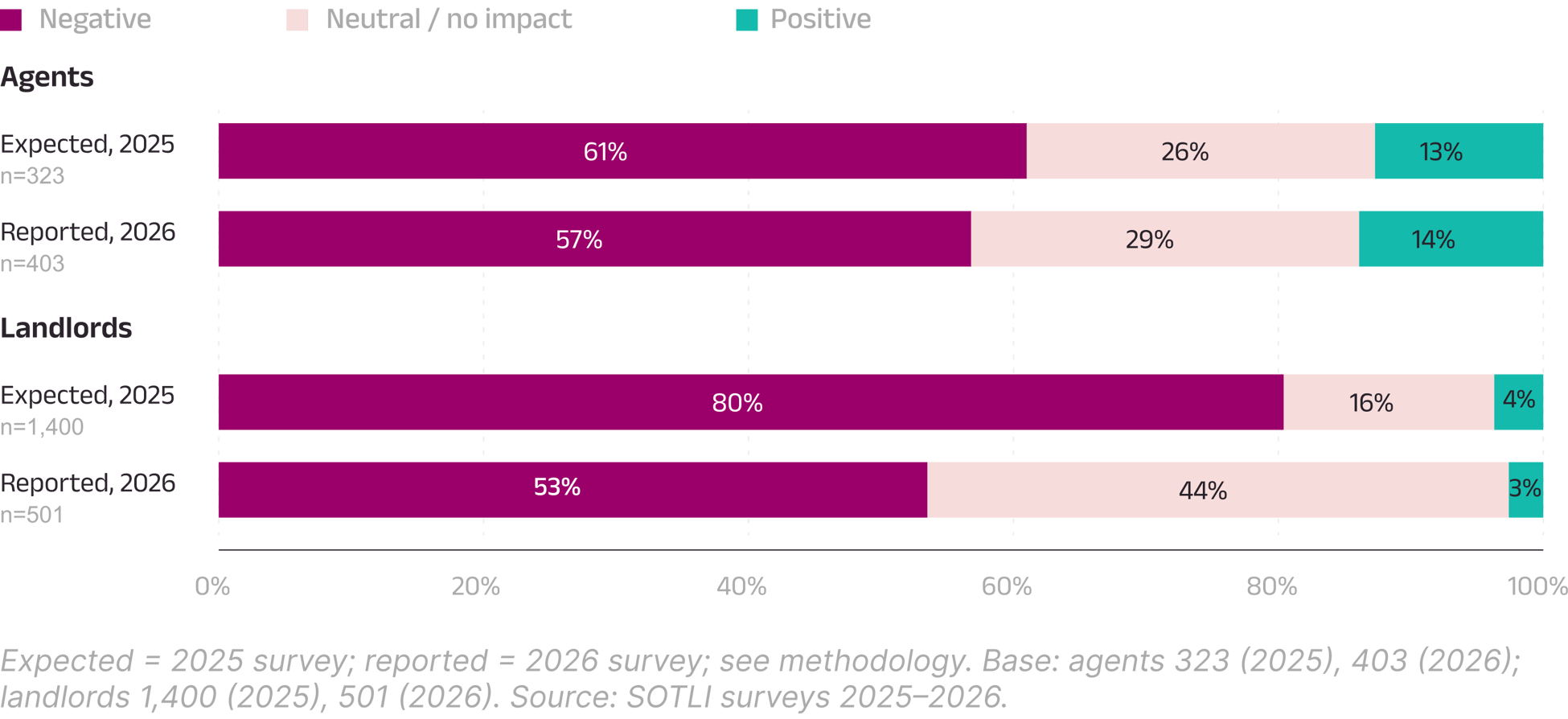
The abolition of Section 21 remains a difficult adjustment for many agents and landlords. In our survey, 57% of agents report a negative impact on their business, as do 53% of landlords. For landlords, that’s well below the 80% who expected a negative impact last year, though most have moved to “no impact” rather than seeing a positive one.

Because our survey took place about three months after the Act came into force, few landlords would have completed evictions using Section 8, which may explain the shift. The pendulum could swing back as more cases work through the system.

With Section 8 providing the grounds-based possession route for affected tenancies in England, 43% of agents report increased time and administration in managing possession cases. A third report increased costs too, while 24% say outcomes have become less predictable as a result.

For landlords, the prospect of a lengthy possession case can weigh on a letting decision long before a problem ever arises. More than half of respondents (54%) anticipate that an eviction would take at least six months, including 16% who expect it to take more than a year.

Those are their expectations. Ministry of Justice figures put the median time from a landlord’s claim to repossession at 27.1 weeks (6 months and roughly 7 days) for April-June 2026, and that clock only starts once the notice period has ended. So the 54% expecting six months or more are being realistic, while 24% expect it to be quicker.

Fig 6: Expectations vs reported impacts - Abolishing Section 21

Fig 6: Expectations vs reported impacts of abolishing Section 21. Agents: 61% expected a negative impact and 57% reported one. Landlords: 80% expected a negative impact and 53% reported one.
Headshot of David Smith

David Smith

Partner, Bishop & Sewell

“The findings in Goodlord’s State of the Lettings Industry report highlight the practical concerns around possession. Some 43% of agents report spending more time and administrative effort managing possession cases, while a third report higher costs. For landlords, this uncertainty can shape decisions long before a tenancy begins, particularly when weighing the risks of a future eviction.

“However, it is important that possession is approached as a legal process, not simply a commercial decision. Landlords should seek appropriate advice early, understand the grounds available to them, and follow the correct procedures at every stage. Tenants also need clarity about their rights and the circumstances in which landlords may seek possession.

“The challenge is to ensure that stronger tenant protections are balanced by a possession process that is fair, proportionate and workable in practice. Without that balance, uncertainty risks undermining confidence and investment in the private rented sector.”

Fig 7: Abolishing Section 21 has made agents and landlords more cautious

Rent protection

Agents: recommending more landlords take out rent protection insurance.

62% (n=257)

Landlords: purchased new or improved rent guarantee insurance.

22% (n=121)

Choosing tenants

Agents: more cautious when recommending prospective tenants.

51% (n=211)

Landlords: more cautious when selecting tenants.

50% (n=278)

Keeping tenants

Agents: more focused on helping landlords find and retain good tenants.

46% (n=188)

Landlords: more focused on finding and retaining good tenants.

41% (n=224)

Referencing

Agents: strengthened referencing and screening.

44% (n=182)

Landlords: improved screening and referencing.

22% (n=122)

Multiple choice; excludes skipped; n = respondents selecting each option. Source: SOTLI surveys 2026.

Agents are seeking protection before problems arise, with 62% recommending Rent Protection Insurance to landlords. 44% have also strengthened their tenant referencing and screening processes.

Meanwhile, half of landlords (50%) have become more cautious when selecting new tenants, and 22% say they have purchased rent protection insurance. Agents should check in to understand the details of their landlords’ existing policies to ensure they are fully covered.

02-letting-under-new-rules-1
Headshot of Oli Sherlock

Oli Sherlock

Managing Director of Insurance at Goodlord

“With the private rented sector facing greater uncertainty around possession, rising administrative costs and changing tenancy arrangements, Rent Protection Insurance is becoming an increasingly important consideration for landlords.

“It can provide valuable financial reassurance when rent payments are interrupted, helping landlords manage the risk of arrears and protect their rental income. As the market adapts to the Renters’ Rights Act, having the right protection in place can give landlords greater confidence to continue letting, while enabling agents to offer a more comprehensive service to their clients.”

An existing tenant who pays the rent and looks after the property becomes more attractive when finding a replacement feels riskier. Among agents, 46% are doing more to help landlords find and retain good tenants, while 41% of landlords are placing greater emphasis on retention.

Our findings show that landlords are clear on where agents can add value.

Asked which qualities matter most in their ideal letting agent (they could choose as many as they liked), 86% of landlords chose thorough tenant referencing and fraud prevention, 83% finding and retaining high-quality tenants, and 81% expert knowledge of rental legislation and compliance.

86%

of landlords want thorough tenant referencing and fraud prevention from their ideal agent

83%

value finding and retaining high-quality tenants

Headshot of Suzanne Smith

Suzanne Smith

Author of The Good Landlord Handbook

“Six months in, The Scorecard shows that the tenancy reforms have bedded in with less drama than most feared.

“For landlords such as myself with single lets and long-term tenants, the Renters’ Rights Act means a bit more admin. Success in any business relies on providing great products, attracting customers and keeping them happy. The RRA doesn’t change that.

“The picture is different for HMO and student lets, where the end of fixed terms means higher turnover and longer voids.

“I’m not surprised the rent in advance ban has landed worse than expected. The rules are badly drafted and a well-intentioned measure has made it very tricky for agents to align rent payments with the first of the month. It’s also left overseas students and those with a poor credit history needing to provide a UK guarantor, or pay for a professional guarantor.

“My biggest beef with the RRA is that it is overly complicated, adding layer upon layer to what was already a dense area of law. It’s too early to see how the courts will interpret the Act’s many ambiguities. That’s great for housing law specialists, as they’ll have a steady stream of work for the next decade or so.

“For those who don’t want to end up as a test case, the safest approach is to interpret ambiguity in the tenant’s favour, keep good records, and leave others to fight it out in court.”

  • Prediction 4 of 8 ·■ Agents● Landlords

    Banning rent in advance will create an insider vs outsider divide

Goodlord’s 2025 report warned that tenants who relied on rent in advance could struggle to find housing once the ban took effect. Our data this year suggests a divide is emerging between market insiders and outsiders.

Tenants already in a property (the insiders) now feel secure. However, it’s a different story for the outsiders.

Last year’s research showed that while some renters offered rent in advance to compete for a property, others did so to reassure the landlord because they couldn’t provide a guarantor. Now that lever is no longer available.

A photo of a house front seen through a grid of circular cut-outs, showing brick walls, white pillars and steps, black iron railings, and a “For Sale” sign at the top.
Fig 8: The outsiders – Why applicants are being rejected under the new rules

…poor credit or County Court Judgments (CCJs)

47% (n=192)
24% (n=126)

…limited UK credit or rental history

16% (n=66)
20% (n=107)

…received benefits or had children

5% (n=22)
13% (n=67)

…wanted to keep a pet

5% (n=20)
11% (n=60)

Multiple choice; excludes skipped; n = respondents selecting each option. Source: SOTLI surveys 2026.

Among agents, 51% have become more cautious when recommending applicants, and 47% say they have recommended against applicants with poor credit histories or County Court Judgments since the RRA took effect.

Asked how the ban on rent in advance has changed their approach to prospective tenants, 33% of landlords say they are now more cautious about applicants with limited UK credit or rental history; the same proportion are more cautious about those with poor credit or County Court Judgments.

Because of the ban, 26% of landlords say they are more likely to reject applicants they would previously have accepted, and 31% are more likely to leave a property empty while they wait for a lower-risk applicant.

All of this suggests that renters on the margins are likely to feel the negative effects of the legislation most. Early signs suggest this could already be playing out.

Overall, tenants’ experience of the ban on rent in advance is mixed. Among tenants in England who knew about the ban and have looked for a home since, 30% say they have found it harder to secure a property or believe landlords are more cautious about renting to them, while 29% say it has made renting easier.

But experiences differ by financial position.

In chapter 3, we look at three affordability pressures (see Figure 12): spending more than 30% of take-home pay on rent, having personal debt, and having less than £500 in savings.

Among tenants facing all three, 23% say they have found it harder to secure a property, compared with 14% of those facing none. Fewer of those under all three pressures say the ban has made renting easier (26% compared with 37%).*

*The base for tenants facing none of the three pressures is under 100 (73), so it should be treated as direction of travel only.

31%

of landlords are more likely to leave a property vacant while they wait for a lower-risk applicant

  • Prediction 5 of 8 ·■ Agents

    Agents’ renewal revenue will be wiped out, leaving a financial black hole

Replacing renewal fee income was a clear challenge for agencies following the transition to periodic tenancies. Our 2025 report found that, on average, agencies relied on renewals for 27% of their annual revenue.

Asked how far Section 13 notice income has replaced renewal fees, 18% of agents say it has fully replaced them or now generates more, and 20% say it has partly replaced them. But 23% say it has replaced little or none of that income. The remaining 39% don’t charge for notices, never charged renewal fees, or don’t know.

Scale makes a clear difference.

Half (51%) of agencies with 11 or more staff have recovered at least some of that revenue, compared with 31% of those with five or fewer and 30% of those with six to 10.

Larger agencies are also more likely to charge for Section 13 notices. Just 6% don’t, compared with 18% of agencies with five or fewer staff and 14% with six to 10.

The shortfall is sharpest among smaller agencies, with 19% of those with five or fewer staff saying notice revenue hasn’t come close to replacing renewal fees, compared with 17% of those with six to 10 and 11% of those with 11 or more.

Full replacement remains rare at every size (11–13%), as does generating more than before (2–9%).

18%

say S13 income has fully replaced renewal fees, or now generates more

23%

say it has replaced little or none of that income

51%

of agencies with 11 or more staff have recovered at least some revenue

94%

of larger agencies charge for S13 notices

  • Prediction 6 of 8 ·■ Agents● Landlords

    Pet requests will create widespread disruption

Fewer agents report a negative impact from pet reforms than expected when surveyed last year. In 2025, 49% anticipated a negative effect on the sector. But post-RRA, only 28% report a negative impact, while over half (52%) report no impact. In fact, 20% of agents report that “pets in lets” reform has had a positive impact.

Requests have increased for 42% of agents, but half say the number has stayed about the same. Among landlords, 54% report no impact from the pet provisions, while 43% report an adverse impact and a further 3% report a positive one.

Of course, it’s still early days. A request to keep a pet can be recorded now; any longer-term effects to property condition will take more time to assess.

49%

of agents expected a negative impact from pet reforms in 2025

28%

report a negative impact in 2026

  • Prediction 7 of 8 ·■ Agents

    Rent increases will face frequent challenges

So far, frequent appeals against rent increases look to be a minority experience for agents. Among agents, 34% say they encounter Section 13 appeals rarely and 41% occasionally or never. Only 8% encounter them frequently or very frequently, and 17% don’t know.

Last year, 22% of tenants said they intended to appeal any rent increase. A further 76% said they would do so if they believed the rent increase was unfair. However, among tenants in England whose rent has risen in the past six months, 21% challenged or appealed the increase, while 55% accepted it without challenging it.

As awareness grows, the gap between intention and reality could close. 12% of those whose rent rose didn’t know they could challenge it, and a further 12% plan to next time.

21%

challenged or appealed a rent increase; 7% had it reduced or withdrawn, while 14% had it upheld

55%

accepted their increase without challenging it

  • Prediction 8 of 8 ·■ Agents● Landlords

    The transition to periodic tenancies will mean tenants come and go more often

Agents are seeing more movement. Almost half (49%) report increased tenant churn since the RRA took effect, while 44% have seen no change and 7% report less. Most of the increase is slight. Just 10% of agents describe it as significant.

Among agents seeing more churn, 72% say void periods have increased, around a third of all agents. Tenants’ answers point the same way, even if the numbers look smaller. In the three months between the Act taking effect and our survey, 7% of tenants in England served notice, and 70% of those say the Act influenced their decision.

Because each agent manages many tenancies, even a small rise in the share of tenants moving is enough for many agents to notice more churn across their portfolio. Most tenants still expect to stay put, though.

49%

of agents report increased tenant churn

72%

of those seeing more churn say void periods have increased

Section 03

Finding a home and paying for it

Supply, demand, and affordability

Key takeaways

  • Half of agents report falling rental availability, while many tenants expect to keep renting. Finding an alternative home may remain difficult for those who need to move.
  • Limited savings leave many tenants poorly placed to absorb another increase. Landlords’ rent-review and improvement plans could add pressure.
  • Stronger rights cannot resolve affordability issues. The cost of staying, and the difficulty of moving, could erode tenants’ confidence in the government.

A dense crowd of people holding rain-spotted umbrellas, mostly black, on a wet city street, with a red double-decker bus and grand stone buildings in the background.

Half of agents (50%) report a fall in available rental properties, while 28% report a rise. Meanwhile, 45% of agents report more tenant enquiries, while 26% report fewer.

These findings describe agents’ experience of their markets rather than a count of national rental stock, but they point to pressure on both sides of the search: more enquiries for agents to handle and fewer alternatives for applicants.

In London, 40% of agents report rising enquiries, while 50% report falling availability. In the South East, the equivalent figures are 45% and 53%. Reports of falling availability reach 60% in the South West and 64% in Yorkshire and the Humber. In the West Midlands, 47% of agents report increased availability.

These figures are based on 25 agents in Yorkshire and the Humber and 32 in the West Midlands and should be treated with caution.

Fig 9: Agents say there are more renters and fewer homes
  • Tenant enquiries n=435

    +19%.
  • Available properties n=437

    −22%.

Net % of agents reporting an increase

Net = % reporting an increase minus % reporting a decrease; excludes skipped. Source: SOTLI agent survey 2026.

Section 03 · Supply

Shaping future supply

27%

of landlords are shrinking their holdings

Most landlords report unchanged or growing portfolios. In this year’s survey, 67% have left their portfolio unchanged over the past 12 months. Just 3% have added to their portfolio in that time, and another 3% are trying to but haven’t yet bought.

The remaining 27% are shrinking their holdings. 11% have already sold at least one property, while 16% are trying to sell but haven’t yet.

Most tenants expect their next step to be staying in their current home or moving to another rental. With the government acknowledging the difficulty of meeting its 1.5 million homes target, new house building cannot ease that pressure quickly. Stronger tenant rights need to be matched by homes people can actually secure and afford.

Among landlords reducing their portfolios, 24% intend to leave the sector within 12 months and a further 23% within 1–2 years. Another 23% intend to leave but do not know when.

Among landlords with six or more properties, 15% tell us they’ve reduced their portfolio but intend to remain in-market, compared with 9% who have reduced it with the aim of leaving. Another 22% are trying to sell part of their portfolio. Meanwhile, 9% have increased their holdings over the past year.

Asked to choose all the reasons that apply, landlords reducing their portfolios or leaving the sector most often cite the Renters’ Rights Act (65%). Fear of further legislation follows at 51%, then taxation changes at 49%. Higher running costs (37%) and better investment opportunities elsewhere (30%) show that regulatory concerns sit alongside other financial decisions.

Fig 10: Bigger landlords are more likely to sell, but smaller landlords are faster to leave

Reducing their portfolio

Share of all landlords in each group

  • 15%

    1 property n=246

  • 32%

    2–5 properties n=241

  • 48%

    6+ properties † n=89

  • 27%

    All landlords n=577

Planning to leave within two years

Share of landlords asked about leaving

  • 68%

    1 property n=41 †

  • 48%

    2–5 properties n=79 †

  • 26%

    6+ properties n=43 †

  • 47%

    All reducing n=163

n = base for each bar; † base under 100, treat as indicative; excludes skipped. Source: SOTLI landlord survey 2026.

Section 03 · Demand

Many tenants expect to keep renting

39%

of tenants expect to stay in their current home

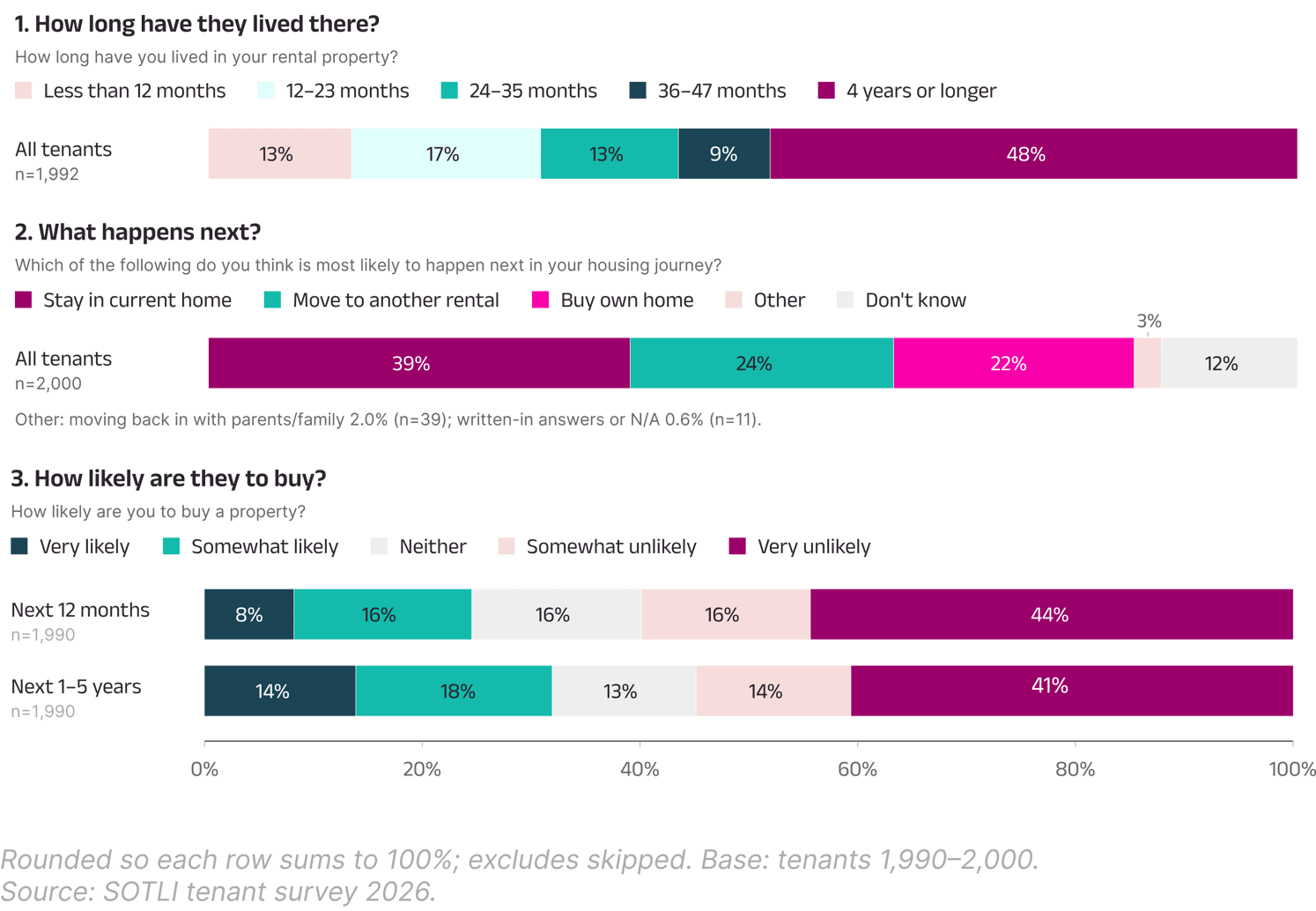
Staying in their current home is the most common next step for 39% of tenants. Another 24% plan to move to a different rental property, while 22% see buying as their next objective.

Only 24% of those surveyed say they are likely to buy within the next 12 months, up from 17% last year, while 60% say it is unlikely.

These expectations suggest demand for rented homes will remain substantial. Unless supply grows, tenants moving into homeownership may free up too few properties to ease competition, making access harder for new renters and those who need to move. And, as we covered earlier, a divide is already emerging between insiders and outsiders.

A photo of a busy crowded street seen through a grid of circular cut-outs, with a dense crowd in focus at the top and blurred figures in the foreground below.

Fig 11: Renters are staying put, making the picture more challenging for “outsiders”

Fig 11: Renters are staying put, making the picture more challenging for “outsiders”. 48% of tenants have lived in their home for four years or longer. 39% plan to stay in their current home, 24% to move to another rental and 22% to buy. 44% say buying in the next 12 months is very unlikely.

But what’s clear is that, for many respondents, renting has already meant years in the same home. Some 70% of tenants have lived in their current property for at least two years, including 48% who have stayed for four years or longer. Those tenancies began before the RRA reforms and long stays are already part of the rental market the RRA is changing.

Section 03 · Rents

Rent reviews test tenants’ financial resilience

59%

of tenants in England whose rent has risen during their tenancy report an increase in the last six months

Among tenants, 73% have experienced a rent increase during their current tenancy. Given the length of many tenancies, that is a broad historical measure. More immediately, 59% of tenants in England whose rent has risen during their tenancy report an increase in the previous six months.

This six-month window includes time before the May reforms. It therefore cannot establish how many increases resulted from the Act.

Those who have been in their tenancies for longer have been significantly affected by recent rent increases, with 60% of those asked who have been in their home four years or more receiving one. Over the course of their tenancy, 61% of this group haven’t had a significant rent increase, 37% have, and 2% aren’t sure.

Landlords’ plans suggest annual reviews will remain important. 42% expect to raise rents on existing tenants annually, and 28% say the move to periodic tenancies makes them more likely to use Section 13 annually.

Property improvements could add further pressure. Of the landlords who told us how they’d fund EPC upgrades, 31% hope to recover some of the cost through rent.

When we look at the figures involved, we can see why. The English Housing Survey 2024–25 estimates that bringing a privately rented home rated EPC D or below up to band C costs £7,040 on average, and that fewer than a quarter (23%) of homes needing improvement would cost £10,000 or more. Landlords expect it to cost more: 38% of those with homes below EPC C expect upgrades to cost £10,000 or more per property.

For a tenant working through the household budget, stronger rights and an affordable rent have to work together. Confidence in being allowed to stay offers limited reassurance if the cost makes staying impossible.

Labour’s stronger standing among tenants could come under pressure if renters welcome their new rights but struggle to pay for their homes. There are early signs of this. Tenants who say a 6.5% rise (the increases shown by Goodlord’s Rental Index from June 2025-2026) would cause them financial distress are less likely to back Labour on housing (23%, compared with 30% of other tenants).

Among those facing all three financial pressures (see Figure 12), 21% say none of the parties would have a positive impact, double the 10% among those facing none.

A man loading or unloading a removal van packed with boxes, furniture and wrapped belongings, parked at the kerb of a quiet city street lined with tall buildings.

Section 03 · Affordability

Many tenants have little financial buffer

53%

of tenants spend more than 30% of their take-home income on rent

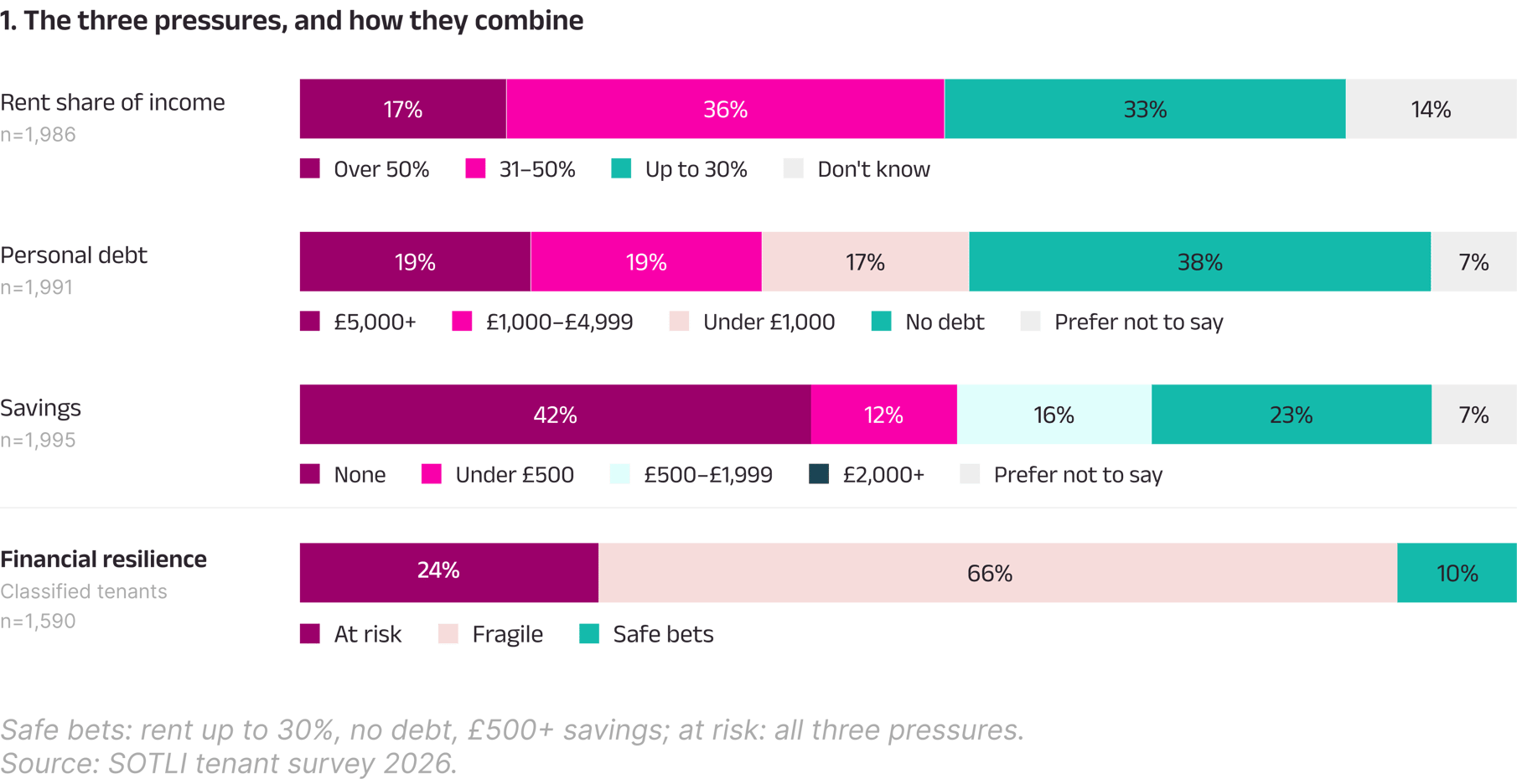
Among the tenants we surveyed, 53% report spending more than 30% of their take-home income on their rent. For 17% of all tenants, rent takes more than half their income.

Many tenants say they don’t have much money in reserve when the next bill arrives. Among tenants, 55% have personal debt, excluding mortgages, student loans, and credit cards paid off in full. Excluding pensions, 42% have no savings or investments they could access quickly. Another 12% have less than £500, bringing the share with under £500 available to 54%.

As Figure 12 shows, this leaves only 10% of renters as “safe bets” for landlords, while 24% face all three pressures at once. For them, a rent rise is a real threat. Faced with a 6.5% increase, 35% of tenants say they would experience financial distress, and 17% say it would harm their mental health.

A group of young adults sitting on a yellow sofa in a cosy living room, each looking at their own phone, with a bookshelf and warm fairy lights behind them.

Fig 12: Only 10% of renters are safe bets for agents and landlords

Fig 12: Only 10% of renters are safe bets for agents and landlords. Combining rent as a share of income, personal debt and savings, 24% of classified tenants face all three pressures (at risk), 66% are fragile and 10% are safe bets.

The most common response to a 6.5% rent rise would be to negotiate with the landlord or agent but ultimately pay if required (41%). Another 11% would give notice and look for cheaper accommodation, 8% would challenge the increase formally, while 4% would take in a flatmate or housemate.

In a market with fewer available homes and more cautious landlords, a tenant giving notice to find somewhere cheaper could exchange a rent they struggle to afford for an uncertain search. Limited savings leave little room to tackle either problem.

Ben Grech headshot

Ben Grech

CEO, Reposit

“Tenant affordability continues to be stretched, not just by rental prices but by the upfront cost of renting, too. Reposit has found that 27% of renters are having to take on repayable debt to afford their cash deposit. That’s seven percentage points higher than a year ago.

“The idea of a cash deposit acting as an indicator of a tenant’s financial stability is outdated. Professional referencing combined with products that give landlords greater protection against the risk of arrears is the best way to navigate the current rental market.”

Section 04

Preparing for future changes

What’s next for the PRS?

Key takeaways

  • Agent sentiment towards the database and ombudsman has become less favourable since last year.
  • Larger agencies appear better placed to absorb further reform, while smaller teams must take on new responsibilities alongside day-to-day lettings work. However, agents still have opportunities to grow their revenue. 35% of landlords with six or more properties still manage some homes themselves and could need help.
  • AI could help more tenants exercise their rights, changing the questions and challenges agents handle.

A pair of Victorian semi-detached houses, one in yellow brick and one painted red, with white bay windows and ornate arched doorways, as a person in a red jacket walks past on the pavement.

Fig 12: Only 10% of renters are safe bets for agents and landlords

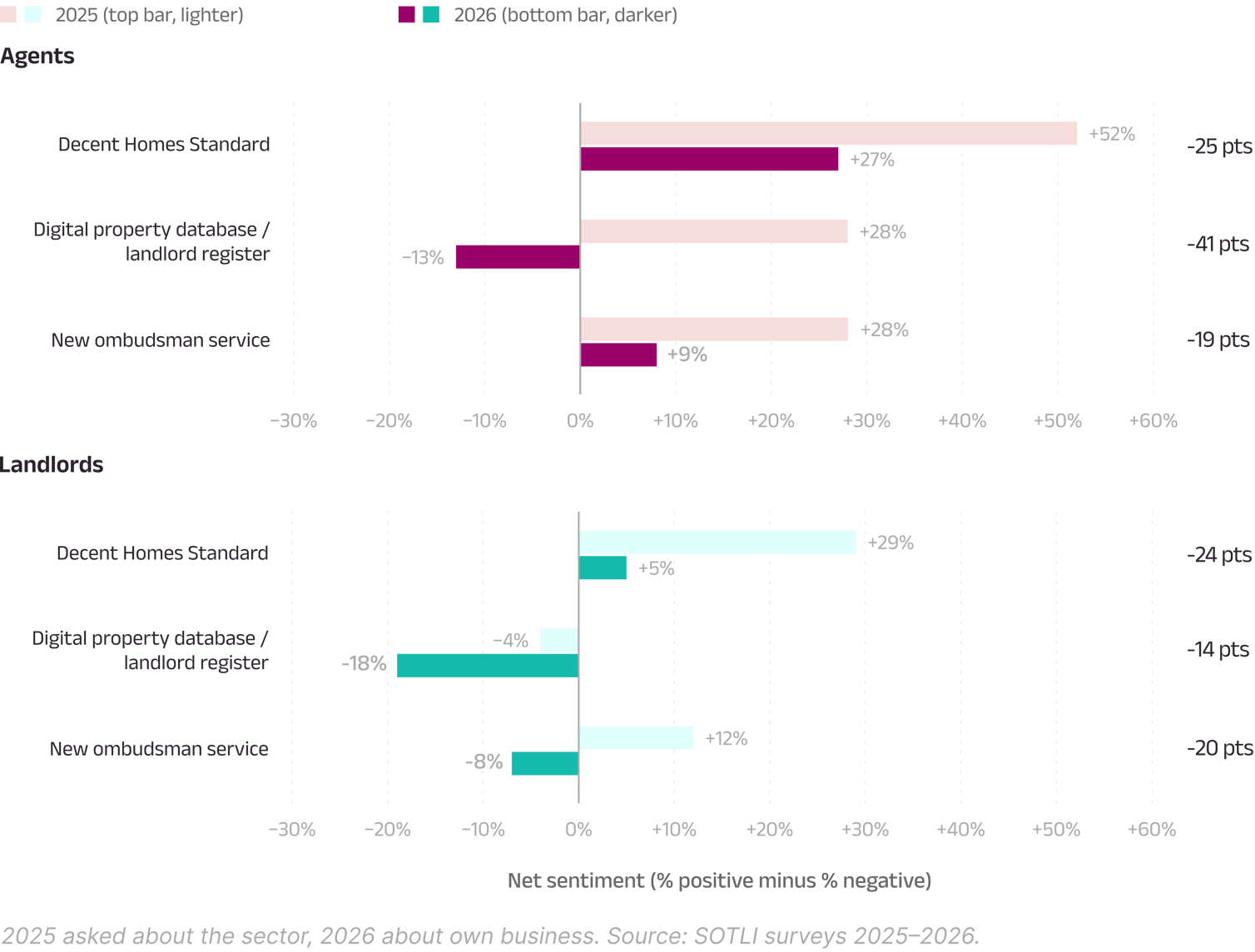
Fig 13: Support for the next wave of reform has cooled sharply. Agents’ net sentiment fell 25 points for the Decent Homes Standard (+52 to +27), 41 points for the digital property database (+28 to −13) and 19 points for the new ombudsman (+28 to +9). Landlords’ fell 24, 14 and 20 points, to +5, −18 and −8.

Support for the next phase of reform is weakening among agents as the practical demands of implementation come into focus.

In 2025, positive expectations among agents exceeded negative expectations by 28 percentage points for both the database and the ombudsman. This year, however, the ombudsman’s positive balance has narrowed to nine points, while the database has moved into negative territory, at minus 13 points.

It’s a substantial change, and it suggests that further administration is becoming harder to welcome.

The database attracts the more negative response. Among agents, 43% expect a negative impact and 30% a positive one. Landlords take a similar view. 42% expect a negative impact and 24% a positive one.

Agents remain more positive about the ombudsman, with 39% expecting a positive impact and 30% a negative one. Among landlords, that balance reverses with 30% expecting a positive impact and 38% a negative one.

These findings return to a concern raised earlier in this report: Agents and landlords feel their experience is not being heard. Their more negative view of the next reforms may reinforce that sense of not being consulted.

Larger agencies are more positive

Among agencies with 11 or more staff, 49% expect the ombudsman to have a positive impact. That compares with 32% among those with five or fewer staff and 34% among those with six to 10.

Larger agencies are also the only group in which positive expectations for the database, at 39%, exceed negative expectations, at 35%. Even here, the margin is narrow, and our fieldwork took place in August, before unpopular implementation details emerged in October.

This pattern echoes earlier report findings: larger operations appear better placed to absorb change.

For a smaller agency, preparation may fall to the same people handling applications, repairs and rent reviews. Time spent interpreting requirements or updating records has to come from somewhere. Supporting more professional practice therefore depends partly on whether smaller firms can manage the work alongside their existing responsibilities.

49%

of agencies with 11+ staff expect the ombudsman to have a positive impact, vs 32% of those with five or fewer

39%

of larger agencies expect a positive impact from the database – the only group where positives outweigh negatives (35%)

Angharad Trueman headshot

Angharad Trueman

Group Lettings Director, Andrews

“The decline in confidence surrounding the introduction of the landlord database is unsurprising, given the scale and pace of regulatory change currently being experienced across the private rented sector.

“Whilst the principle of improving transparency, accountability, and standards is widely recognised, there are legitimate concerns about the practical implications of implementation, particularly the additional administrative and financial pressures placed upon landlords and letting agents.

“Professional agents have already invested significant resources in preparing for and implementing the Renters’ Rights Act. The introduction of further regulatory requirements, without sufficient clarity around responsibilities, processes, and associated costs, risks placing additional strain on businesses operating within an increasingly complex legislative environment.

“It is particularly important that the database does not simply duplicate information already held by agents or other regulatory bodies, creating additional work without delivering meaningful improvements for consumers.

“For the database to achieve its intended objectives, implementation must be proportionate, supported by clear guidance and developed through meaningful engagement with those responsible for delivering it in practice.

“Ultimately, successful reform should not be measured solely by the introduction of new regulatory requirements, but by whether those measures deliver tangible improvements in standards, consumer protection and confidence across the private rented sector.”

Property standards receive a more positive response

Among agents, 54% expect Awaab’s Law (which concerns the response to serious hazards) to have a positive impact, while 18% expect a negative one. Applying the Decent Homes Standard to private rentals attracts positive expectations from 48% and negative expectations from 21%.

Landlords are more reserved, but positive expectations still exceed negative ones for both measures. For Awaab’s Law, the figures are 42% positive and 21% negative. For the Decent Homes Standard, they are 34% and 29%, respectively.

54%

of agents expect Awaab’s Law to have a positive impact

48%

of agents expect the Decent Homes Standard to have a positive impact

42%

of landlords expect Awaab's Law to have a positive impact

34%

of landlords expect the Decent Homes Standard to have a positive impact

Section 04 · AI

Tenants are turning to AI to understand their rights

68%

of agents see tenants use AI to draft emails or formal letters

Further legislation is only part of what agents need to prepare for. Tenants are also finding new ways to understand and exercise the rights they already have.

AI is entering that process. Among tenants surveyed, 24% have used it to understand their rights and 23% to understand a tenancy agreement. Finding or comparing rental properties follows at 19%, then drafting correspondence at 18%, while 9% have used it in disputes and 5% to appeal a Section 13 rent increase.

Agents are already seeing the effects of this in their inboxes. Some 68% report seeing tenants use AI to draft emails or formal letters, 59% to raise complaints or disputes, and 50% to challenge tenancy terms or decisions. These observations cover agents’ experience across tenancies, so they are not directly comparable with individual tenants’ reported use.

For a renter unsure how to question a decision, help in understanding an agreement or drafting a letter may make it easier to act. Some will identify legitimate concerns they might previously have left unchallenged. Others may arrive with confident but mistaken advice, leaving the agent to explain where it goes wrong.

Close-up of a person’s hands typing on a laptop keyboard, wearing a smartwatch and a checked shirt, framed in an overlapping double-circle shape.
Fig 14: Tenants say they’re using AI to understand their rights rather than to challenge them, but agents see AI elsewhere

What tenants say they use AI for

Base n=1,950

  • 24%

    Understanding my rights as a tenant n=471

  • 23%

    Understanding my tenancy agreement n=446

  • 19%

    Finding or comparing rental properties n=369

Where agents notice tenants using AI

Base n=429

  • 68%

    Drafting emails or formal correspondence n=291

  • 59%

    Raising complaints or disputes n=254

  • 50%

    Challenging tenancy terms or decisions n=215

Questions differ, so compare patterns, not bar lengths; top three per group. Source: SOTLI surveys 2026.

This gives the Scorecard’s early findings a longer-term significance. Frequent rent appeals remain uncommon among agents surveyed, but tenants’ understanding of the rules is still developing. AI could help more people put a challenge together, although it may also resolve questions before they become disputes. Either way, agents should expect more questions, and more informed ones, before they see more formal cases.

For agencies, the workload may change before the number of formal cases does. Clear records, sound explanations, and staff who understand the legislation will matter increasingly when decisions are questioned. Larger businesses may have specialists to turn to; smaller teams will need to consider where that support comes from. Helping landlords respond fairly and accurately gives agents another opportunity to demonstrate the value of their expertise as reform becomes part of everyday renting.

Kristjan Byfield headshot

Kristjan Byfield MARLA

Co-founder at The Depositary

“Whether landlords or letting agents, there is no question: our industry is becoming a profession. The rapidly increasing legislative burden and tax landscape favours larger operational structures. This is happening in parallel with the rise of the AI-enabled tenant: a far more informed entity that is all too ready to actively enforce their array of rights (and not always correctly). Over the next decade, we will see both landlords & agents shrink in number but grow in size.”

Section 05

Five findings worth a closer look

We’ve touched on several key themes throughout this report. Here they are at a glance:

A person’s eyes and fingertips peering out through the open letterbox of a white front door.
  1. 01 Greater certainty is restoring some confidence

    Agents and landlords appear more comfortable working with known rules after years of uncertainty. Their improving outlook is cause for optimism, but there’s still a long way to go.

  2. 02 Security inside a tenancy can come with harder access to the next

    More cautious selection may reassure landlords while narrowing applicants’ options. A settled tenant can encounter that barrier as soon as they need to move.

  3. 03 Affordability issues could undo tenants’ early optimism

    Stronger rights matter, but tenants’ savings and debt make any rent increases painful. With homes in short supply, finding somewhere cheaper will be challenging.

  4. 04 Smaller agencies face a harder adjustment

    Larger firms are better placed to spread compliance costs and draw on specialist resources. Smaller teams must absorb new responsibilities alongside the daily work of keeping tenancies running.

  5. 05 Agents’ and landlords’ warnings deserve a hearing

    Some concerns about possession and applicant selection are reflected in early experience. Drawing more on agents' and landlords' experience will ultimately help tenants.

Conclusion

Why agent and landlord voices must be heard

A key with a wooden fob hanging in the brass lock of an open white door, with a bright, sparsely furnished room and window blurred in the background.

The Renters’ Rights Act has strengthened tenant rights and given the sector greater certainty after years of upheaval. Agents and landlords are less pessimistic, and tenant optimism has reached its highest level on record. Knowing the rules gives people something to plan around, even when they disagree with them.

But there are storm clouds ahead. Stronger rights cannot make unaffordable rent manageable or provide a home where none is available. Half of agents report falling rental availability. At the same time, many tenants have little financial cushion, while landlords face costs that some intend to recover through rent. Until housing supply and affordability improve, Labour’s honeymoon with tenants could be short-lived.

The warning signs extend beyond household budgets. Because of the ban on rent in advance, a quarter of landlords report being more willing to reject applicants they would previously have accepted, and agents describe advising against applicants with poor credit or limited rental histories.

Hurting the most vulnerable renters was never the government’s intention. But to avoid unintended consequences like this, agents and landlords must be heard.

Security, access, and affordability

77%

of tenants feel secure.

26%

of landlords are more likely to reject applicants they previously accepted.

54%

of tenants have under £500 readily accessible.

Section 07

Who took part?

Demographics and methodology

We heard from 3,031 people who let, manage, or rent homes. Here’s who took part and how we gathered their views.

A wall of worn green metal mailboxes in a grid, each with a lock and a numbered flat label from 101 to 403, one with “305” handwritten beside its label.

How the research was conducted

The State of the Lettings Industry 2026 report draws on three separate online surveys conducted through Attest. Fieldwork was conducted on 12 August 2026, with 3,031 verified respondents: 442 lettings professionals, 589 landlords, and 2,000 tenants.

The lettings professionals and landlords came from Goodlord’s own contact database, while Attest provided the tenant respondents.

The surveys used single-choice, multiple-choice, and grid questions. Subgroup differences were tested at the 95% confidence level. This report describes the findings without treating every difference as statistically significant.

Who took part

The agent sample covers the UK and includes owners, directors, department heads, property managers, and negotiators. In the agent sample, 40% work in agencies with 2-5 staff, and 22% in agencies with 6-10 staff. Greater London and the South East account for 44% of respondents combined.

The landlord survey covers people actively letting private rental property in England and Wales. Of these landlords, 74% are aged 60 or over. Single-property landlords account for 43% and landlords with 2-5 properties for 42%. Their properties are concentrated in the South East and Greater London. In this sample, 95% use a letting agent for some or all of their portfolio, so the findings particularly reflect landlords who work with agents.

The tenant survey covers adults currently renting a house or flat privately across the UK. Of these tenants, 32% are aged 18-34, 47% are 35-54, and 21% are 55 or older. The sample covers every English region, as well as Scotland, Wales, and Northern Ireland.

Almost half of tenants have lived in their current property for at least four years.

How to read the results

The audiences are reported separately. The headline survey totals are overall samples; questions restricted to people who moved, plan to leave, or meet other conditions have smaller bases. Percentages for those groups should not be applied to the full sample. Multiple-choice responses can total more than 100% and rounding can affect totals.

The tenancy reforms discussed in this report apply in England, so questions about them were asked only of agents based in England (417), landlords with at least one property in England (569) and tenants renting in England (1,712). Percentages for those questions use these smaller bases. Questions on wider topics, such as finances, sentiment and politics, were asked of the full samples.

The survey records perceptions, experiences, and intentions. It cannot by itself establish that legislation caused a change, or that a stated intention will become an action.

The PRS Sentiment Index shows net sentiment: the percentage of respondents who are optimistic minus the percentage who are pessimistic. Comparisons between 2025 expectations and 2026 experience are directional: question wording, sample composition, geography, and exposure to reforms can differ. Regional and portfolio subgroup results warrant particular care where bases are small.

Other sources

The 6.5% rent increase used in the tenant survey comes from Goodlord’s Rental Index (June 2025 to June 2026). Historical context and expectation comparisons draw on the published State of the Lettings Industry 2025 report, and possession timescales on Ministry of Justice statistics for April–June 2026.

Descriptions of the English reforms were checked against the government’s implementation roadmap, tenant overview, and rent in advance guidance. The survey findings remain the evidence base for the report’s analysis.

Comparisons with the wider private rented sector in England draw on the English Housing Survey 2024-2025, published by the Ministry of Housing, Communities and Local Government.