Days
Hours
Minutes
Seconds
May 1 2026 - Renters' Right Act Commencement Day
You have 0 days to:
Serve any final Section 21 notices
Stop accepting above-asking rent offers
Prepare for the rental bidding ban
Remove “No DSS” from adverts
Remove “No Children” from listings
Show one clear rent price
Stop using fixed-term agreements
Switch to periodic tenancy templates
Check which tenancies go periodic
Stop taking rent before signing
Take no more than one month’s rent
Move all evictions to Section 8
Train staff on new notice rules
Create Section 13 process flow
Add two months to rent reviews
File court claims for Section 21s
Update landlord move-in grounds
Update landlord selling grounds
Send the RRA Information Sheet
Create written terms where missing
Update How to Rent processes
Review tenant screening questions
Update pet request processes
Stop backdating rent increases
Discuss rent protection backbooks
Act now before it is too late...
The Renters’ Rights Act Toolkit is a set of cards designed to support teams as the upcoming changes come into force.
Each card focuses on a specific issue, helping you work through what’s changed, how it affects your processes, and what to do next.
The cards can be used individually or together. Teams can dip in when questions come up, use the cards in discussions, or keep them close as a working reference when reviewing processes and handling real scenarios.
What you'll gain from the toolkit
Clarity on what’s changing
Clear explanations of the key Renters’ Rights Act reforms, focused on what has actually changed and where it affects agency workflows.
Understanding the impact
Each change is mapped to its operational and commercial impact, so teams can see where risk sits, what processes are affected, and where pressure is likely to show up first.
Clear next steps
Every section leads to action. The cards help teams work through what needs to change, what to review, and what to tighten.
Guiding principles
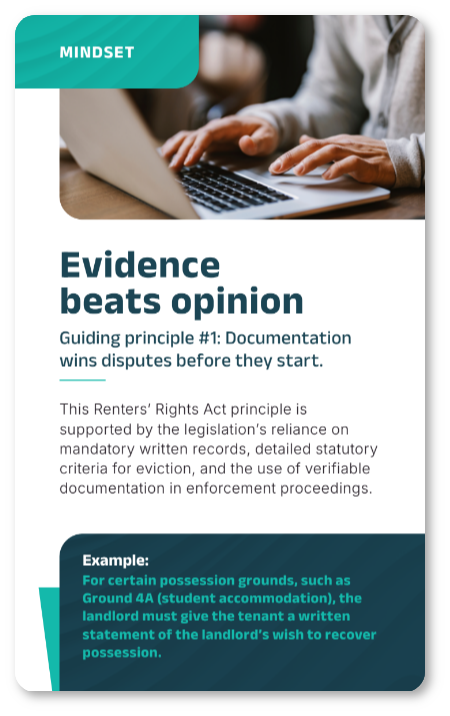
This card introduces one of the core principles behind the Renters’ Rights Act: decisions will increasingly be judged on what you can evidence, not what you intended.
It explains:
-
Why written records matter more under the Act
- How documentation is used in enforcement and dispute resolution
- Where agencies are most exposed if records are incomplete
The card includes a real legislative example, showing how this principle applies in practice, such as possession grounds that require written statements and verifiable records.
This card is designed to reset thinking before teams move on to process or action.


Practical advice
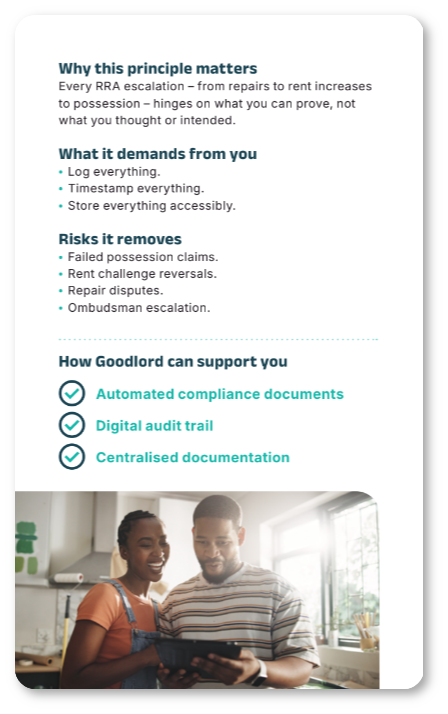
The next card builds directly on the principle, focusing on how it plays out in real agency workflows.
It covers:
-
Why evidence underpins rent increases, possession and repairs
-
What teams need to log, timestamp and store
-
The types of disputes and escalations this approach helps avoid
It also shows how Goodlord supports this in practice, through automated documents, digital audit trails and centralised records, so teams can see how the principle is applied consistently.
Together, these cards show how the Toolkit moves from mindset → impact → action, using real scenarios rather than theory.
Download the Toolkit and get clear on what to do next, with confidence in your approach.